How to set up a loyalty program in 2026
A practical six-step guide to launching a loyalty program customers actually use: goals, mechanics, earn rates, launch tactics and the numbers to watch.
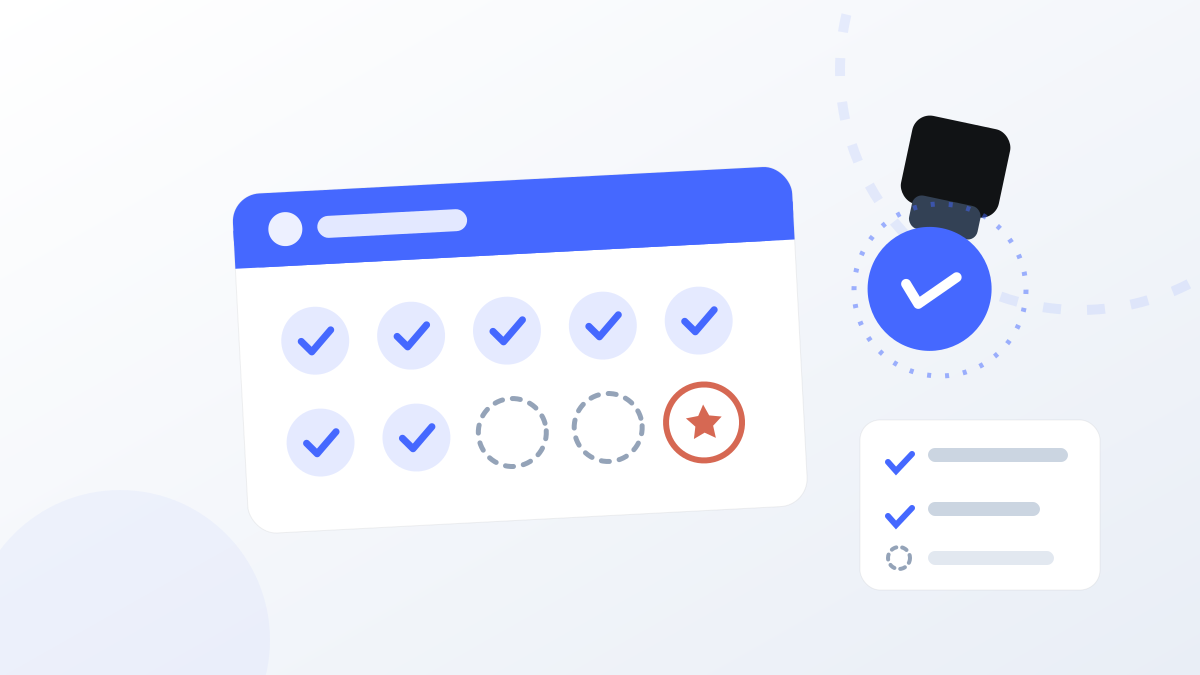
Most independent businesses spend real money getting a new customer through the door and almost nothing on getting that customer back. That is the wrong way round. Frederick Reichheld's research at Bain in the 1990s showed that small improvements in retention produce outsized improvements in profit, and the logic has not changed since: a returning customer costs nothing to acquire, needs less persuading, and brings friends.
What has changed is where a loyalty program lives. Contactless payment made the phone the default object in a customer's hand at the counter. At the same time, app fatigue is real — nobody installs a separate app for their bakery, their barber and their café. By 2026 the practical middle ground has won: the loyalty card as a pass in Apple Wallet or Google Wallet. No plastic, no printing, no download. It is added in a few taps and, unlike a paper card, it cannot be left at home.
Below are the six decisions that determine whether your program works, in the order you should make them.
Step 1 — Decide what the program is for
A loyalty program is a tool, not a goal. Before you think about cards or rewards, decide which one job it should do:
- More repeat visits. The classic goal for cafés, bakeries, barbers — anywhere the product is bought weekly or monthly. Design consequence: reward the visit itself.
- Bigger baskets. For shops where visits are already frequent but spend per visit is low. Design consequence: a stamp per spending threshold ("one stamp per €10"), not per visit.
- Winning back lapsed customers. The hardest of the three, because you first need a channel to reach people who have stopped coming. Design consequence: you need a medium that can push a message — a wallet pass can receive updates; a paper card in a drawer cannot.
Pick one primary goal and write it down as a sentence with a number in it: "Within six months, I want 30% of first-time customers to come back within a month." Everything that follows — the mechanic, the earn rate, what you measure — should serve that sentence. Programs that try to do all three jobs at once usually end up as a vague standing discount that does none of them.
Step 2 — Choose the mechanic
There are three basic mechanics:
- Stamps. One qualifying visit or purchase equals one stamp; a full card equals a reward. Binary, visual, finished in a known number of steps.
- Points. Spend-based: one point per unit of currency, rewards at various point levels. Flexible and precise, but it demands mental arithmetic from the customer.
- Tiers. Status levels with escalating perks. Powerful for airlines and large retail chains, where customer value varies enormously.
For an independent shop, choose stamps. Not because points or tiers are bad mechanics — because of the counter. A loyalty program gets explained during a payment, by a staff member holding a card machine, to a customer who is half-listening. "Every tenth coffee is free" survives that moment. "One point per crown, and 500 points gets you 50 off selected items" does not. If the customer has to think, the moment is gone.
If your staff can't explain the program in one sentence, customers won't join it. Design for the counter, not the boardroom.
Points and tiers earn their complexity only when your customers differ hugely in spend and you have the data discipline to exploit that. Most independents don't, and don't need to.
Step 3 — Pick the medium
In 2026 a small business has three realistic options: a paper card, its own app, or a wallet pass. Here is the honest comparison:
| Paper card | Your own app | Wallet pass | |
|---|---|---|---|
| Cost to start | Cents per card plus printing | Tens of thousands of euros to build, plus ongoing maintenance | A platform subscription; self-serve setup in under an hour |
| Customer friction | None to accept — but easy to lose, forget or leave at home | High: download, account, permissions. Most customers decline | Low: added in a few taps; no app, no sign-up form |
| Data you get | None. You don't know how many cards are out there or alive | Everything — if people actually install and keep using it | Cards issued, stamps given, rewards redeemed, per location |
| Risk of loss/fraud | High: lost cards and self-inked stamps are routine | Low | Low: stamps only via a staff scan or NFC tap |
To be fair to each row: paper still has a place. If you only want to test whether your customers care about loyalty at all, a month of paper cards is the cheapest pilot there is. An own-brand app almost never makes sense below chain scale — the build cost is the smaller problem; the bigger one is that customers won't install it. The wallet pass is the middle path: near-zero friction for the customer, real numbers for you, plus things paper physically can't do — the pass can update itself (a new reward, changed opening hours, a news item) and can surface on the lock screen when the customer walks past your shop.
Step 4 — Set the earn rate
Two rules of thumb, both old and both still good:
- The reward should be reachable within 4–8 typical visits for your kind of business. Make it fewer and you give margin away to people who would have come anyway. Make it many more and most customers abandon the card before their first reward.
- The reward should be worth roughly 5–10% of the spend needed to earn it. Below 5% it stops feeling worth the ritual; above 10% you are running a permanent sale.
Worked example with coffee: 10 stamps, one per drink, and a full card earns a free drink. At €4 a drink, the customer spends €40 to earn a reward worth €4 — exactly at the 10% ceiling. Ten visits sounds like it breaks the 4–8 rule, but that rule is really about time, not visits: what matters is that a typical regular reaches the reward within about a month. Someone buying three coffees a week completes the card in around three weeks — fine. A hair salon running a 10-stamp card would be asking for a two-year commitment — not fine. Scale the card length to your visit frequency.
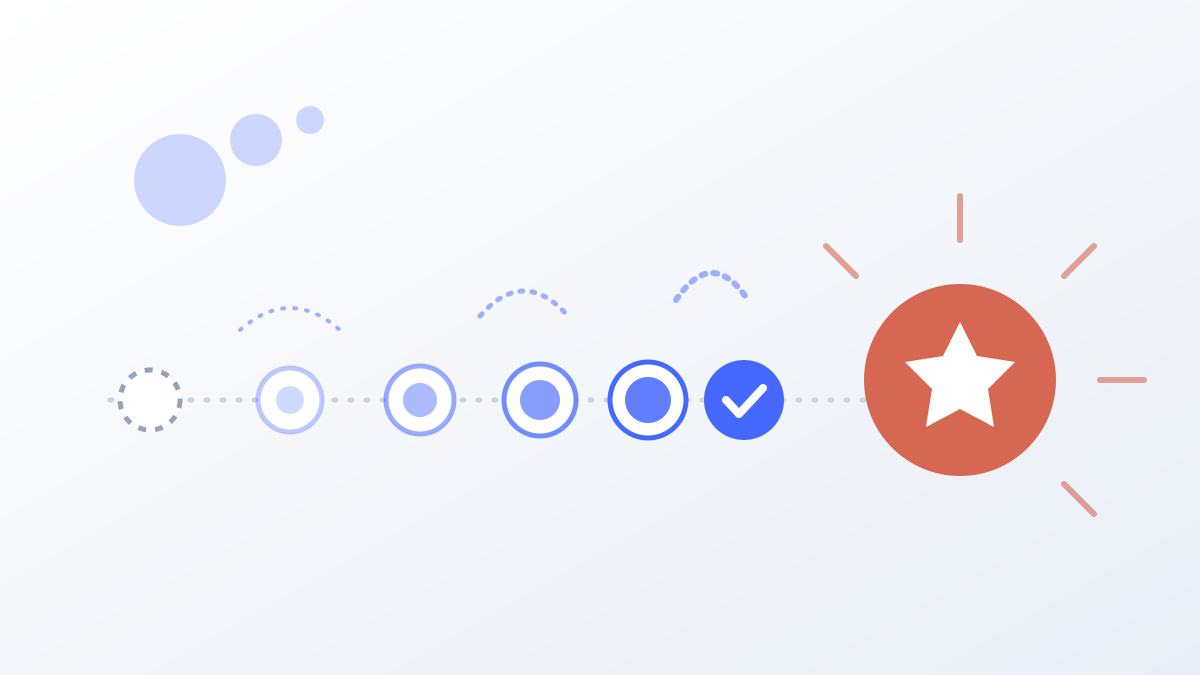
Two research findings are worth knowing here. Kivetz, Urminsky and Zheng (2006) observed café customers buying faster the closer they got to a free coffee — the goal-gradient effect. And Nunes and Drèze (2006) showed that a 10-stamp card with two stamps already filled in outperforms an 8-stamp blank card, even though the required effort is identical — endowed progress. The practical consequences: make progress visible on the card, and start people off with a stamp or two. More on that next.
Step 5 — Launch it right
Programs rarely fail on design. They fail at the counter in the first four weeks. Three things prevent that:
- Give staff a one-liner and rehearse it. Script it word for word: "Want a stamp card? It goes straight into your phone wallet — scan this, no app needed." One sentence, said while the customer is already waiting for the terminal. Run it once with every shift before launch day.
- Put a QR stand where the customer already looks. Next to the card terminal, not by the door. The customer scans it, the pass lands in their wallet in a few taps, and staff stamp the first stamp on the spot.
- Double the first stamp. For the launch month, start every new card with two stamps instead of one. It costs almost nothing and puts the endowed-progress effect from step 4 to work from the first second.
Announce the program online too — Google Business profile, social channels — but treat that as support. The counter will drive the large majority of sign-ups; the online announcement mostly reassures people the program is real.
Step 6 — Measure and iterate
Check three numbers once a month:
- Repeat-visit share. Of the customers who joined, how many came back within your natural purchase cycle? This is the number your step 1 sentence was about — if it doesn't move over a quarter, the program isn't doing its job.
- Reward redemption rate. Of the rewards earned, how many were actually redeemed? Healthy is roughly 20–40%. Far below 20% usually means the card is too long or the reward too dull — people gave up on the way. Far above the band, check your margins: the card may be so short it works like a standing discount. In either case the fix is the earn rate, not the whole program.
- Active cards. Cards with at least one stamp in the last 90 days, against total cards issued. A large pile of dead cards means enrollment works but the habit doesn't stick — shorten the card or add a mid-card nudge.
A digital medium makes this automatic. The Stampit dashboard, for instance, shows cards issued, stamps and rewards redeemed, broken down per location. Cafe Tone, a specialty coffee shop with three locations in Prague, runs one stamp card across all three and can see how each location enrolls and stamps — a comparison that is pure guesswork on paper.
When you adjust, adjust — don't relaunch. A shorter card, a better reward, double-stamp Tuesdays to lift a slow weekday. One change at a time, four to six weeks per change, and keep the three numbers as your referee.
A 30-minute launch checklist
- One primary goal, written as a sentence with a number in it
- Mechanic: stamp card, with the card length matched to visit frequency (a regular should redeem within about a month)
- Reward worth 5–10% of the spend needed to earn it
- Medium set up — for a wallet pass, the Stampit onboarding wizard at partners.stampit.app takes about 15 minutes and starts with a free trial
- Staff one-liner written down and rehearsed with every shift
- QR stand printed and standing next to the card terminal
- Double first stamp switched on for the launch month
- Calendar reminder on day 30: repeat-visit share, redemption rate, active cards
None of this is complicated, and that is the point. The businesses that win at loyalty in 2026 are not the ones with the cleverest program — they are the ones that made joining effortless and then paid attention to three numbers.
Keep reading

Put your loyalty program in every customer's wallet
Set up digital stamp cards for Apple Wallet and Google Wallet in minutes — your customers don't need to install anything.
Start for free