The psychology of stamp cards: why stamp 8 feels different from stamp 2
Why customers speed up as a reward gets closer, what a 1932 rat maze and a 2006 café study showed, and how to design a stamp card around it.

Picture two customers of the same café. Both hold the same buy-ten-get-one stamp card. One has 2 stamps. The other has 8.
The customer with 2 stamps buys coffee wherever is convenient. Your café, the kiosk at the station, the place next to the office — it barely matters. The customer with 8 stamps is different. She walks two blocks out of her way. She skips the kiosk. She has, without quite deciding to, changed her route to work.
Same card, same reward, same price of coffee. The only difference is how close the finish line feels. That difference is one of the best-documented effects in behavioural science, and if you run a loyalty program you should know how it works.
The goal-gradient effect
In 1932, the psychologist Clark Hull noticed something odd about rats in a maze: they ran faster as they got closer to the food at the end. Effort wasn't constant — it climbed with proximity to the goal. He called it the goal gradient.
In 2006, Ran Kivetz, Oleg Urminsky and Yuhuang Zheng tested the same pattern where it matters for you: a real café loyalty program. They tracked buy-ten-get-one coffee cards and measured the time between purchases. Customers behaved like Hull's rats. The gap between visits shrank as the card filled up — people bought coffee number nine sooner after coffee number eight than they had bought coffee number three after number two.
Two details are worth pinning to the wall:
- Acceleration is about perceived distance, not absolute effort. Stamp 8 of 10 motivates more than stamp 2 of 10, even though each coffee costs exactly the same.
- The effect resets after redemption. Once the reward is collected, the customer is back at zero — psychologically the furthest possible point from the next goal — and visit frequency drops back down.
A stamp card is not a flat discount spread over ten purchases. It is a motivation curve, weak at the start and strong at the end. Most stamp-card design questions reduce to one: how do you deal with the weak start?
The endowed progress effect
Also in 2006, Joseph Nunes and Xavier Drèze published an elegant answer, from a field experiment at a car wash. They handed out two kinds of loyalty cards. One needed 8 stamps for a free wash. The other needed 10 — but came with 2 stamps already filled in.
The required effort was identical: 8 washes either way. The results were not. Around a third of the pre-stamped 10-slot cards were completed, against roughly one in five of the empty 8-slot cards — and the pre-stamped group finished faster, with shorter gaps between visits.
The framing did the work. An empty card says: you haven't started. A card with 2 of 10 stamps says: you're already 20% of the way there — don't waste it. People are reluctant to abandon progress, even progress they were given for free. Nunes and Drèze called it endowed progress, and it is the cheapest motivational tool available to a small business: it costs you nothing but ink.
What this means for card design
Taken together, the two effects give you a short, practical checklist.
Pre-stamp the first visit. Never hand out an empty card. Stamp it once (or twice) on the spot, ideally with a sentence attached: "First one's on us — nine to go." That converts the program's weakest psychological moment into a small gift.
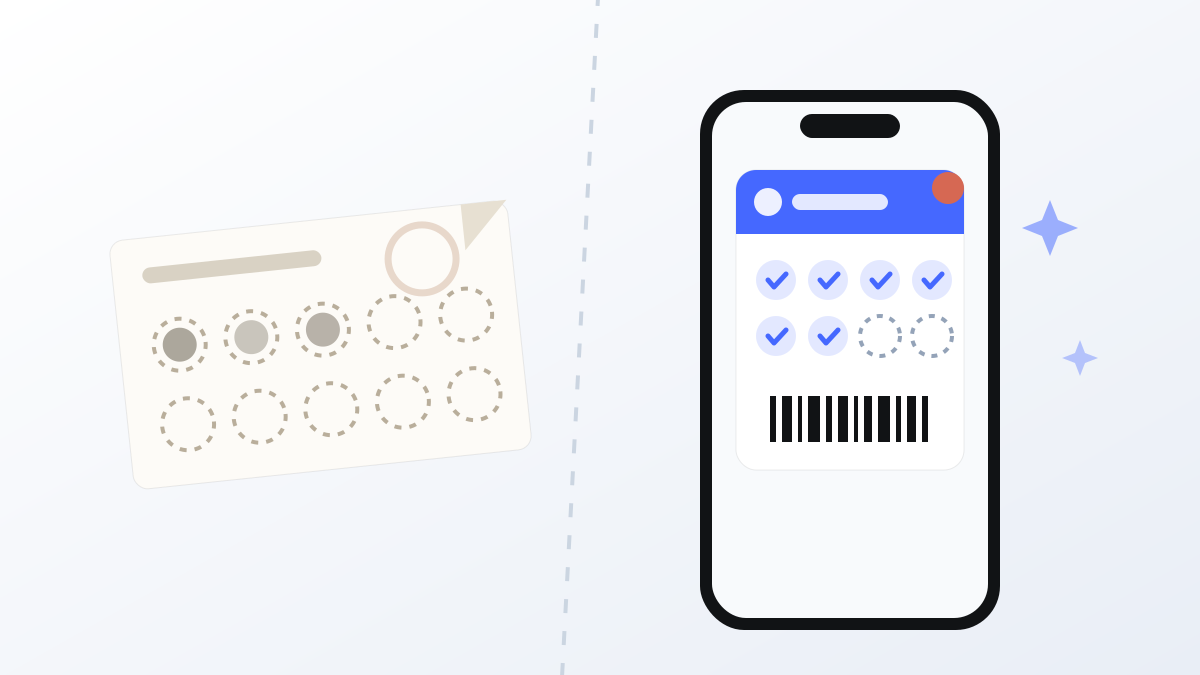
Make progress visible without asking for effort. The goal gradient only works if the customer actually sees the gradient. A paper card buried in a wallet shows its progress once per visit at best. A card that lives in Apple Wallet or Google Wallet is one swipe away, and a location-aware pass can surface itself on the lock screen when the customer is near your shop — which is precisely the moment "8 of 10" needs to be seen. This, more than convenience, is why digital stamp cards outperform paper: they keep the goal in view.
Keep the goal within reach. A useful rule of thumb: a regular customer should be able to complete the card in four to eight weeks. For a daily coffee habit, ten stamps is comfortable. For a haircut or a car wash, ten stamps means a year of loyalty before any payoff — the gradient never gets steep enough to matter. Five or six slots fit better there. If a card feels generous to you, it's probably about right; if it feels safe, it's probably too long.
Plan for the moment after redemption. Kivetz and colleagues found the post-reward reset is real: freshly redeemed customers slow down. Treat redemption as the start of the next card, not the end of the last one. Start the new card with a stamp already on it, or pair the free coffee with a note that the next round has begun. Some businesses lean into streak framing instead — "your third completed card this year" — which turns each full card into progress toward a larger, ongoing identity: I'm a regular here.
The ethics bit
Everything above can be used well or badly, so it's worth being explicit about the line.
These effects work because they mirror something true: a customer at 8 of 10 stamps genuinely has invested in your shop, and rewarding that investment is fair. Use the psychology to recognise loyalty that already exists and make it feel good — not to manufacture a sense of obligation toward a reward that isn't worth having.
Three rules keep you on the right side. The reward must be real value — a free coffee, not a token discount hedged with conditions. The terms must be transparent — no expiring stamps hidden in fine print, no surprise exclusions at redemption. And the math must hold up under scrutiny, because customers do the math. A program that feels like a trick doesn't just fail; it converts your most engaged customers into your most annoyed ones.
A small experiment to run in your shop
You don't have to take a 2006 car wash study on faith. Replicate it.
For the next eight weeks, run two versions of your card side by side. Version A: your current card, handed out empty. Version B: the same card with two extra slots and two stamps already filled in, so the required effort is identical. Alternate weekly, or simply alternate which version each new customer receives. Mark the cards so you can tell them apart at redemption.
Then count two things: how many of each version come back completed, and roughly how long completion took. With paper cards that means a tally sheet by the till; with a digital program the statistics — cards issued, stamps given, rewards redeemed — accumulate on their own, which is one honest advantage of running the card in a dashboard instead of a shoebox.
If your customers behave like the ones in the published research, version B will win, and it will win by enough to notice. At that point you're no longer copying a study — you're acting on evidence from your own counter.
Keep reading


Put your loyalty program in every customer's wallet
Set up digital stamp cards for Apple Wallet and Google Wallet in minutes — your customers don't need to install anything.
Start for free