Digital vs. paper stamp cards: an honest comparison
Paper stamp cards have worked for decades. Here is what they do well, where they quietly leak value, and when going digital actually pays off.
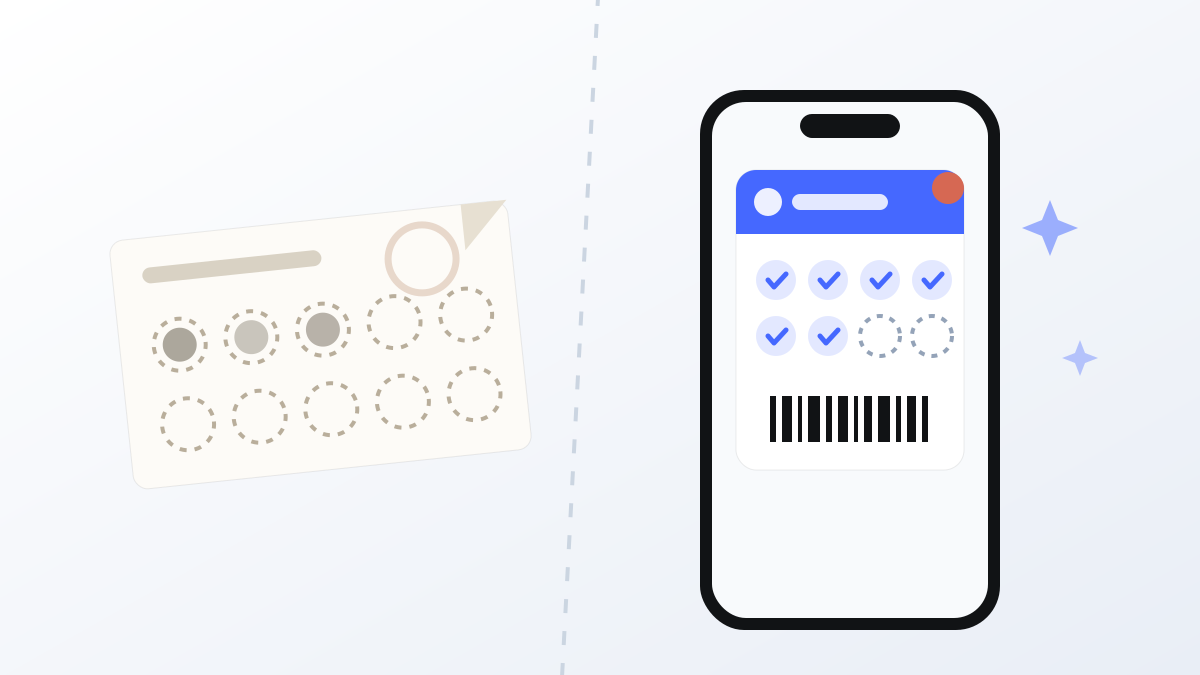
Paper stamp cards have been around for decades, and they have survived for a reason: they work. A card, a rubber stamp, a free coffee at the end — the whole mechanic fits on a business card and everyone understands it in two seconds.
So the honest question is not "is digital better?" It is: what do you trade away by staying on paper, and does that trade matter for your shop? We build digital stamp cards for a living, so read this knowing where we stand — but we will try to argue both sides properly.
What paper does well
Zero learning curve. Nobody has ever needed an explanation of a paper stamp card. You hand it over, you stamp it, done. There is no onboarding, no QR code, no "do you have Apple Wallet?" conversation at the counter.
No technology to fail. A paper card does not need a charged battery, a working phone, an internet connection, or a staff member who knows which app to open. On the busiest morning of the year, a rubber stamp keeps working.
The stamp itself is satisfying. This is easy to dismiss and shouldn't be. The physical thunk of a stamp is a small ritual between staff and customer. It is tactile, it is personal, and some regulars genuinely enjoy watching the row fill up.
Nearly free to start. A stack of printed cards and a stamp cost very little. For a shop testing whether a loyalty program does anything at all, that is a legitimately low-risk experiment.
Where paper quietly leaks value
The problems with paper are not dramatic. They are slow leaks, which is exactly why they are easy to ignore.
Lost and forgotten cards break the streak. The core psychology of a stamp card is visible progress toward a goal — the closer people get, the harder they work to finish (goal-gradient behavior, first described by Hull in the 1930s and shown in loyalty settings by Kivetz, Urminsky, and Zheng in 2006). A lost card resets that progress to zero. A card forgotten at home means a missed stamp, and a missed stamp means the momentum quietly dies. Every wallet cleanout and every washed pair of jeans erodes your program, and you never see it happen.
You have no idea what is in circulation. How many cards have you handed out? How many are active? How many people are one stamp from a reward right now? With paper, the honest answer to all three is "no idea." You cannot measure a program you cannot see, which means you cannot tell whether it is earning its keep.
Self-stamping is a real thing. Most customers are honest. But a stamp left near the till, a stamp design anyone can buy online, or a staff member stamping a friend's card five times — all of it is invisible until reward redemptions stop matching your sales. Paper has no audit trail at all.
Reprints never end. Cards run out, designs change, a new location opens, the reward changes from 10 stamps to 8. Each change means another print run and a drawer of obsolete cards.
You cannot reach the people holding your cards. This is the biggest one. A customer with your paper card in their wallet is someone who chose your shop — and you have no way to tell them about new opening hours, a seasonal menu, or a second location. The relationship exists, but it is mute.
What changes with a wallet pass
A digital stamp card done well is not an app your customers must install. It is a pass in Apple Wallet or Google Wallet — the same place as their boarding passes and event tickets — added in a few taps.
The card is always there. People forget paper cards; they do not forget their phones. Progress survives a lost wallet, a washed jacket, and a new phone. The streak never resets by accident, so the goal-gradient effect keeps working.
Progress is visible without asking. The pass shows six of ten stamps every time the customer glances at it. With location-aware passes, it can even surface on the lock screen when they are near your shop — a nudge no paper card can deliver.
You can finally speak to your card holders. Updates pushed to the pass reach exactly the people who opted into your program: new hours, a new location, a limited offer. No email list to build, no ad budget to spend.
You get real numbers. Cards issued, active cards, stamps given, rewards redeemed — per location, over time. You can see whether the program moves behavior instead of guessing.
Staff still stamp in one tap. With Stampit, staff scan the customer's pass with the Partners app (or tap via NFC). It is one gesture at the counter, and every stamp is logged — which quietly solves the self-stamping problem too.
The honest counterpoints
Some customers prefer paper. A minority of people — often older regulars — will always like a physical card better. If they are a big share of your crowd, keep a small paper option alongside; the two can coexist.
Phones die; systems have moments. A dead phone at the counter is the digital equivalent of a forgotten card. It is rarer, because people guard their battery, but it happens. A rubber stamp has no such moment.
Digital does not fix a bad program. If your reward is stingy, ten stamps take a year, or staff never mention the card, moving it into a wallet changes nothing. The medium is not the strategy. A badly run digital card is just a badly run card with better reporting.
When paper is genuinely fine
Let's be plain about it. If you run a single small shop, you are behind the counter yourself most days, you know your regulars by name, and you have no interest in statistics or reaching customers between visits — paper is fine. Truly. The leaks above are real, but at that scale they are small, and the simplicity is worth something.
The calculus shifts when any of these become true: a second location, staff you do not personally supervise, a card design that keeps changing, or the growing itch to know whether the program actually works. Those are exactly the points where paper's invisibility starts costing real money.
Bottom line
Paper wins on simplicity, ritual, and startup cost. Digital wins on retention of progress, honesty of the data, fraud resistance, and the ability to reach the customers you have already won. For a one-person shop with loyal regulars, paper can be the right call. For anyone with multiple locations, a team, or a genuine question about whether their loyalty program pays for itself, the trade-offs point one way.
If you want to see what the digital side looks like in practice, you can set up a working program at partners.stampit.app in about 15 minutes, with a free trial — no commitment, and your rubber stamp will still be there if you change your mind.
Keep reading



Put your loyalty program in every customer's wallet
Set up digital stamp cards for Apple Wallet and Google Wallet in minutes — your customers don't need to install anything.
Start for free